


ASTM D6595: Used Oil Wear Metals Testing Services
Accredited ASTM D6595 used oil wear metals testing from Infinita Lab, performed to the exact standard requirements - accurate, reproducible results with full documentation for compliance, R&D, and quality control programs.
TRUSTED BY


Get ASTM D6595 compliant results - request your used oil wear metals testing quote
- Overview
- Scope, Applications, and Benefits
- Test Process
- Specifications
- Instrumentation
- Results and Deliverables
What Is ASTM D6595 Used Oil Wear Metals?
ASTM D6595 is the official designation for the Standard Test Method for Determination of Wear Metals and Contaminants in Used Lubricating Oils or Used Hydraulic Fluids by Rotating Disc Electrode Atomic Emission Spectrometry (RDE-AES). The current edition, D6595-22, lays out exactly how a lab turns a few milliliters of oil into a full elemental profile.
Here’s the mechanism the standard specifies: a rotating carbon disc electrode spins just above a sample cup, paired with a freshly sharpened carbon rod electrode held a fixed distance away. A capacitor discharges a controlled high-voltage spark across that gap, vaporizing part of the sample into a plasma running several thousand degrees Celsius. Every element in that plasma emits light at its own characteristic wavelength, and a spectrometer splits that light apart to measure each line’s intensity. Those intensities get checked against certified calibration standards, and the result is a quantitative readout in milligrams per kilogram – numerically the same as parts per million by mass.
The standard’s scope is specific: it covers wear metals, contaminant elements, and additive elements, and it spells out electrode preparation, spark parameters, and calibration procedures so results stay comparable run to run and lab to lab. Because the spark excites whole droplets and suspended debris directly, no acid digestion or ashing is required, and the method can capture particles up to roughly ten microns – a range several competing spectroscopic techniques miss entirely.
Importantly, D6595 isn’t limited to used fluids. Its scope explicitly includes new lubricating oils and hydraulic fluids too, since a lab often needs a fresh-fluid baseline before it can make sense of whatever shows up in later, in-service samples.

Applications and Benefits of ASTM D6595 Used Oil Wear Metals Testing
Scope
ASTM D6595 measures:
- Covers the determination of wear metals, contaminant elements, and additive elements in used lubricating oils and used hydraulic fluids by rotating disc electrode atomic emission spectrometry.
- Applies to both new and in-service lubricants and hydraulic fluids so that a baseline reading can be compared against later trend data from the same equipment.
- Results come directly from the oil sample – no acid digestion, no ashing, no other destructive prep steps required.
- Can excite and measure dissolved metallic compounds along with suspended wear particles up to approximately ten microns in size.
- Elemental concentrations are expressed on a mass basis, commonly milligrams per kilogram, numerically the same as parts per million.
- Meant as a rapid screening and trending tool, not a definitive elemental assay. It’s most meaningful when results get tracked across successive sampling intervals.
- Electrode geometry and excitation conditions affect sensitivity, so the standard spells out electrode preparation, spark parameters, and calibration procedures to keep results comparable between runs and labs.
- Doesn’t distinguish the physical or chemical form an element takes so that a rising reading could reflect dissolved metal or fine particulate debris – either one.
- Spans a broad mix of lubricant and hydraulic fluid types used across industrial, marine, power generation, and transportation equipment.
- Excludes very large wear particles and severe contamination events that fall outside the particle-size range the spark excitation process can vaporize.
Applications
- Routine oil analysis programs for engines, transmissions, gearboxes, and hydraulic systems in fleets and industrial plants.
- Predictive and condition-based maintenance, trending wear metal levels to schedule service ahead of a failure.
- Failure investigation. An unusual spike in one element can help narrow down which component is degrading.
- Warranty and extended-service evaluations that need documented oil condition history for engines or drivetrains.
- Quality control on new lubricant formulations, checking additive element levels before a product ships.
- Contamination monitoring in hydraulic systems, where silicon or sodium readings can flag seal failures or coolant intrusion.
- Used oil recycling and re-refining operations that need elemental profiles to qualify incoming feedstock.
Benefits
- A single small sample delivers a broad elemental profile covering wear metals, contaminants, and additives in one run.
- Minimal sample prep keeps turnaround times short compared to wet-chemistry digestion methods.
- Catches larger wear particles than some competing spectroscopic techniques, giving earlier warning of abnormal mechanical wear.
- Supports long-term trending – often worth more for maintenance decisions than any single data point.
- Helps avoid unplanned downtime by flagging developing component wear while repairs are still relatively cheap.
- Objective, repeatable data that backs up warranty claims, root-cause investigations, and maintenance budgeting.
Our ASTM D6595 Testing Procedure
Sample Introduction
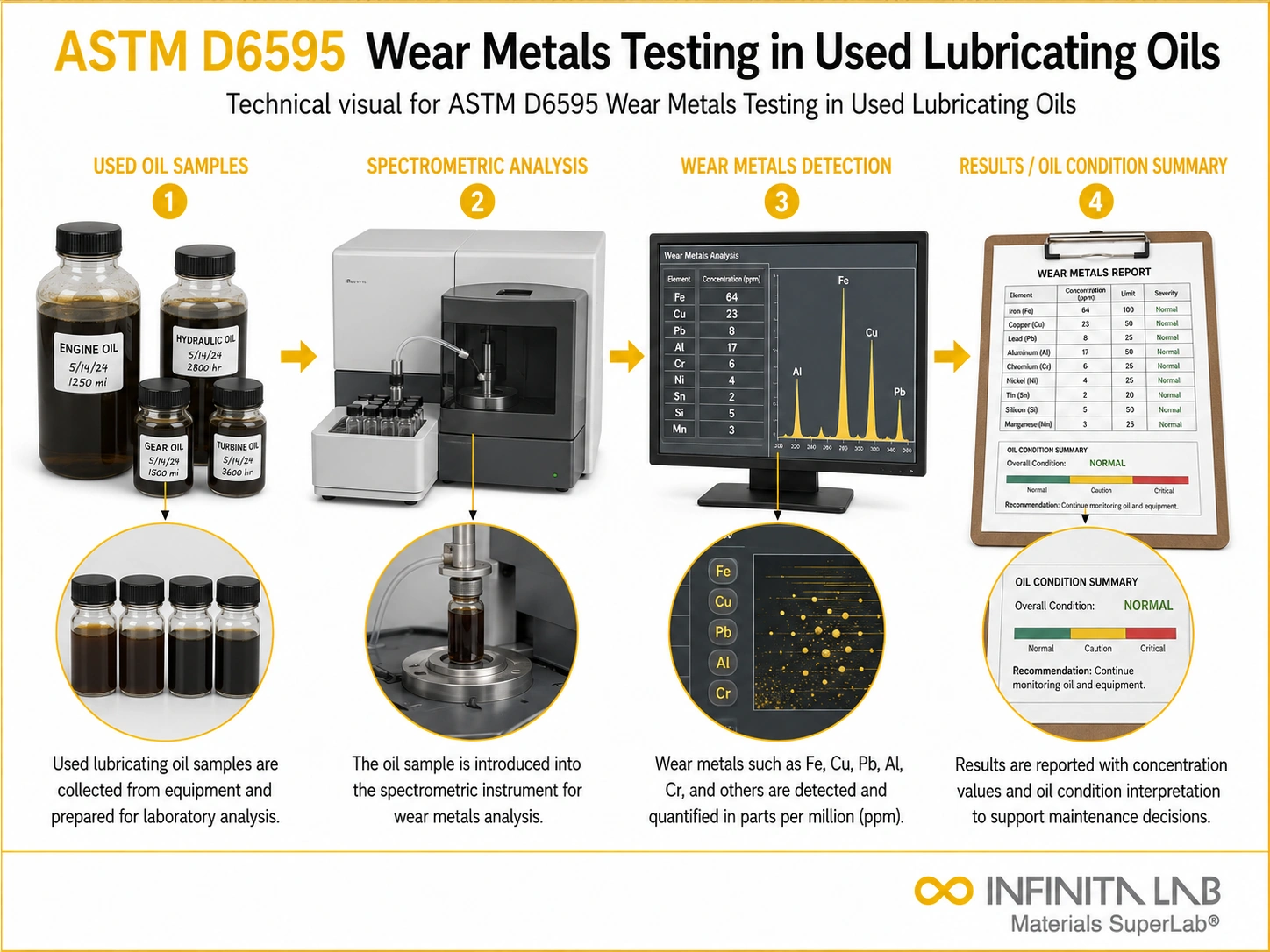
Used oil sample is drawn into the rotating disc electrode (RDE) spectrometer and applied to the electrode surface.
1Arc Excitation
An electrical arc between the rotating disc electrode and a counter electrode vaporizes and excites the metal-containing oil film.
2Spectral Measurement
Emitted light is analyzed by the spectrometer to identify and quantify elemental emission lines for each element of interest.
3Reporting
Elemental concentrations (ppm) are calculated, compared to baselines or limits, and reported with wear condition assessment.
4ASTM D6595 Test Parameters and Requirements
| Parameter | Details |
|---|---|
| Standard | ASTM D6595 |
| Test Principle | Rotating disc electrode atomic emission spectrometry (RDE-AES) |
| Applicable Materials | Used lubricating oils, hydraulic fluids, gear oils |
| Measured Outputs | Elemental concentrations (ppm) for wear, contaminant, and additive metals |
| Detection Range | Sub-ppm to thousands of ppm |
| Sample Volume | Typically 1–3 mL |


- Rotating Disc Electrode (RDE) Atomic Emission Spectrometer – The core analytical instrument. It excites the oil sample and resolves the resulting light into elemental spectral lines.
- Graphite Disc and Rod Electrodes – Consumable electrodes generating the spark discharge; these need to be fresh for each sample to avoid cross-contamination.
- High-Voltage Spark Source – Supplies the controlled capacitor discharge that vaporizes part of the sample into an emitting plasma.
- Diffraction Grating or Polychromator – Separates the emitted light into individual wavelengths so each element’s signal can be isolated.
- Photomultiplier Tubes or CCD Detectors – Convert the separated light signals into electronic measurements proportional to elemental concentration.
- Certified Reference Oils – Calibrate the spectrometer and verify ongoing accuracy throughout a batch of samples.
- Sample Preparation Accessories – Cups, mixing equipment, and warming apparatus used to condition oil before analysis.
Equipment and Instrumentation Used for ASTM D6595 Testing
What You Receive: Test Report, Data, and Certification
- A detailed elemental report listing wear metal, contaminant, and additive concentrations for the submitted sample.
- Trend charts or historical comparisons when multiple samples from the same equipment are analyzed over time.
- Flagging of results outside normal or caution thresholds, so maintenance teams know what to prioritize.
- A clear summary interpretation that helps non-specialist staff understand what the elemental data suggests about equipment condition.
- Digital and hard-copy reporting formats suitable for maintenance records, audits, or warranty documentation.
- Rapid turnaround suited to routine monitoring programs that depend on timely data to schedule maintenance.
ASTM D6595 Used Oil Wear Metals FAQs
Iron, copper, lead, and aluminum are among the most critical wear indicators. Iron reflects cylinder liner and crankshaft wear, copper indicates bearing wear, and aluminum points to piston wear.
Silicon typically indicates dust or dirt ingestion through a faulty air filter or breather, and is one of the most important contaminant elements to monitor, as abrasive particles accelerate component wear.
Sampling frequency depends on the application and criticality of the equipment. Common practice ranges from every oil change to fixed intervals (e.g., every 250–500 operating hours) for critical machinery.
RDE-AES is most effective for detecting elemental metals in fine particle form (typically <5–10 μm). Large wear particles may require complementary techniques such as ferrography or particle counting.
Yes, new oil elemental analysis establishes a baseline for additive levels and contamination, providing a reference for comparison against used oil samples throughout the oil's service life.
Why Choose Infinita Lab for Used Oil Wear Metals Testing
When your Used Oil Wear Metals results have to hold up - for compliance, a customer audit, or an engineering decision - ASTM D6595 accuracy and an unbiased third-party report matter more than price. Infinita Lab routes your ASTM D6595 used oil wear metals testing to ISO/IEC 17025-accredited U.S. partner labs with hands-on method experience, so you get defensible data, transparent reporting, and turnaround times built around your project deadline - not ours.

Need ASTM D6595 Used Oil Wear Metals Testing You Can Rely On?
Send query us at hello@infinitalab.com or call us at (888) 878-3090 to learn more about our services and how we can support you.



Request a Quote
Submit your material details and receive testing procedures, pricing, and turnaround time within 24 hours.
 Quick Turnaround and Hasslefree process
 Confidentiality Guarantee
 Free, No-obligation Consultation
 100% Customer Satisfaction
