


ASTM D6143 Iron Content Testing in Bisphenol A (BPA)
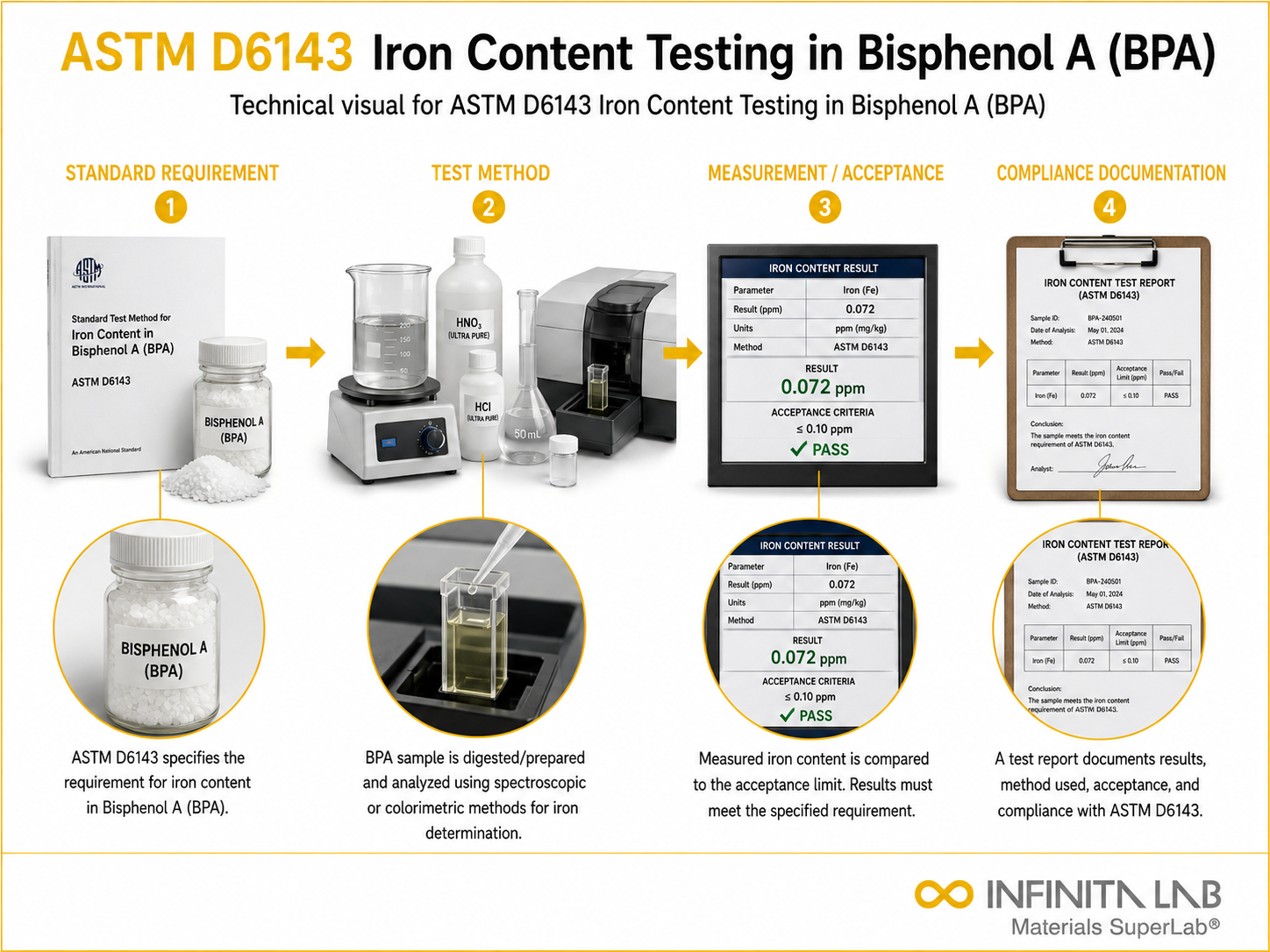
The ASTM D6143 test method describes the procedure to determine the iron content of bisphenol A (4,4’-isopropylidenediphenol). In this test method, iron may also increase the color of bisphenol A and can affect other properties of end-use products.
TRUSTED BY


Precision-driven testing for dimensional accuracy and compliance
- Overview
- Scope, Applications, and Benefits
- Test Process
- Specifications
- Instrumentation
- Results and Deliverables
Overview
ASTM D6143 determines the iron content present in Bisphenol A (BPA), a key raw material used in polymer and resin production. Trace iron contamination can affect product color, stability, and overall performance.
This test method provides precise quantification of iron impurities to ensure material purity and consistency. It is essential for quality control, process monitoring, and maintaining performance standards in applications where BPA is used in high-purity formulations.

Scope, Applications, and Benefits
Scope
This test method measures the concentration of iron in Bisphenol A using suitable analytical techniques to ensure compliance with purity specifications and product quality requirements.
Includes:
- Quantitative determination of iron content
- Analysis of trace metal impurities
- Applicability to Bisphenol A samples
- Support for quality control and specification compliance
- Evaluation of material purity
Applications
- Polycarbonate and epoxy resin production
- High-purity chemical manufacturing
- Raw material quality control
- Industrial chemical processing
- Performance-critical polymer applications
- Research and development laboratories
Benefits
- Ensures high purity of Bisphenol A
- Prevents discoloration in end products
- Improves product consistency and quality
- Supports compliance with specifications
- Enables process optimization
- Reduces risk of contamination-related defects
Test Process
Sample Preparation
The Bisphenol A sample is dissolved and prepared for analysis under controlled conditions.
1Reagent Addition
Specific reagents are added to react with iron and form a measurable complex.
2Measurement
The intensity of the developed color or signal is measured using appropriate analytical equipment.
3Calculation
Iron concentration is calculated based on calibration standards and measurement data.
4Technical Specifications
| Parameter | Details |
|---|---|
| Property Measured | Iron content |
| Material Type | Bisphenol A |
| Method | Chemical or spectrophotometric analysis |
| Measurement Unit | ppm or mg/kg |
| Detection | Colorimetric or equivalent technique |
| Calibration | Standard solutions |
| Sensitivity | Trace-level detection |
| Output | Iron concentration value |


- Spectrophotometer or colorimeter
- Analytical balance
- Volumetric glassware
- Sample preparation equipment
- Reagent handling tools
- Data recording system
Instrumentation Used for Testing
Results and Deliverables
- Iron concentration values
- Calibration and measurement details
- Quality compliance assessment
- Analytical report with observations
- Comparison with specification limits
- Documentation for quality control
Frequently Asked Question
Trace iron can catalyze degradation and cause discoloration in downstream products like polycarbonate and epoxy resins. Controlling iron ensures consistent appearance, stability, and performance, especially in applications requiring high optical clarity or strict purity standards.
Elevated iron levels can lead to yellowing, reduced thermal stability, and unwanted reactions during processing. This can compromise product quality, reduce shelf life, and negatively impact the performance of final polymer products.
By providing accurate iron content data, the method helps manufacturers control raw material quality. This ensures stable processing conditions and consistent properties in resins derived from Bisphenol A.
Acceptable limits depend on end-use requirements, but high-purity applications typically require very low ppm levels. Specifications are defined by manufacturers or industry standards to ensure consistent product performance.
Regular monitoring of iron content ensures that each batch meets required specifications. This prevents variability in final products and supports reliable manufacturing processes.
Why Choose Infinita Lab for Advanced Materials Testing and Characterization?
At the core of this breadth is our network of 2,000+ accredited laboratories across the USA, offering access to over 10,000 testing methods and analytical services. From advanced materials characterization (SEM, TEM, RBS, XPS) to mechanical, chemical, environmental, biological, and standardized ASTM/ISO-compliant testing, we deliver unmatched flexibility, specialization, and scale. You are never limited by geography, facility, or methodology — Infinita Lab connects you to the right expertise and testing solution, every time.

Looking for a Trusted Partner for Accurate and Reliable Testing Services?
Send query us at hello@infinitalab.com or call us at (888) 878-3090 to learn more about our services and how we can support you.



Request a Quote
Submit your material details and receive testing procedures, pricing, and turnaround time within 24 hours.
 Quick Turnaround and Hasslefree process
 Confidentiality Guarantee
 Free, No-obligation Consultation
 100% Customer Satisfaction
