
FTIR Spectroscopy Testing Services for Material Identification
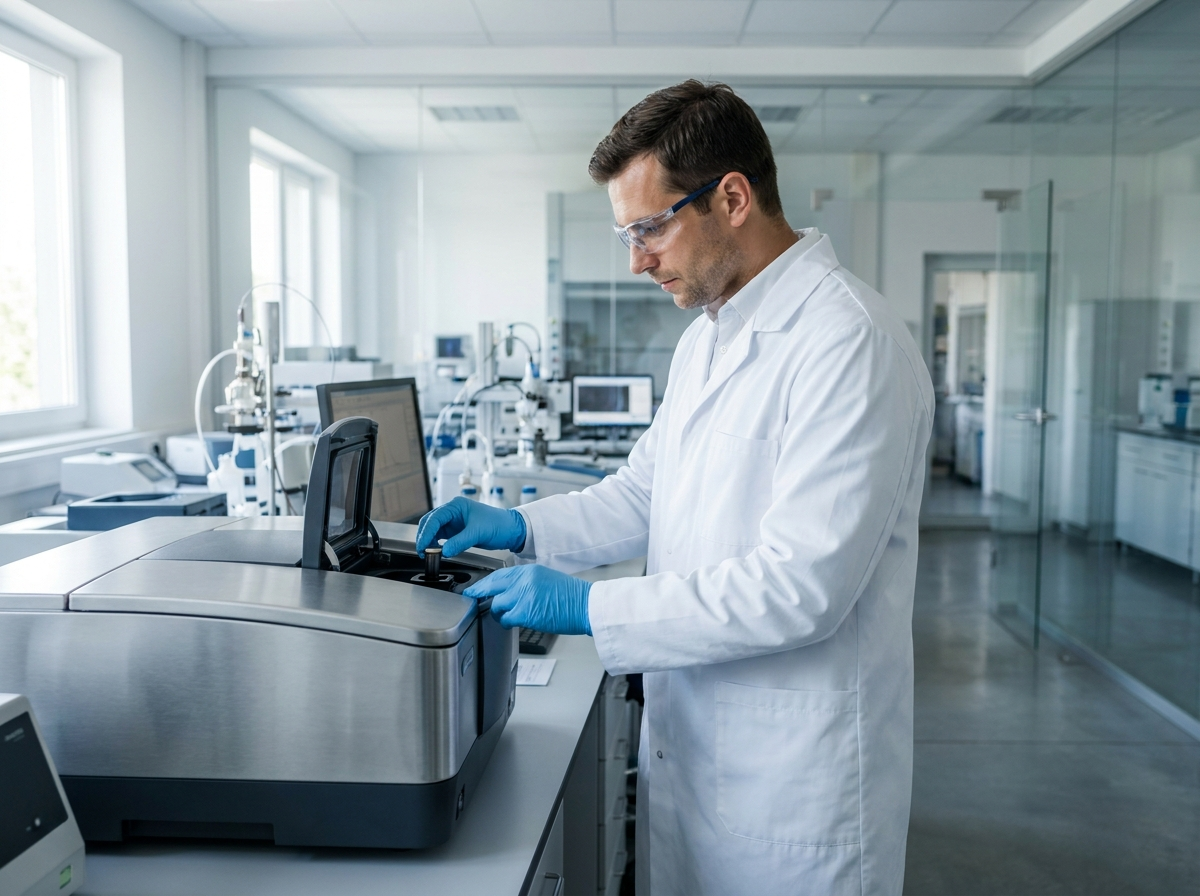
Infrared (IR) Microscopy and Micro-FTIR Spectroscopy are other names for Fourier Transform Infrared Microscopy. In essence, it is a potent analytical instrument that combines FTIR and ocular microscopy, and it is mostly employed in the identification and analysis of the smallest samples and surfaces, down to 5 m in size. It provides reliable chemical/material identification as well as the benefit of optical microscopy for the imaging and localisation of small samples (such as particles, fibres, pollutants, inclusions, and surfaces).
TRUSTED BY


Precision-driven testing for dimensional accuracy and compliance
- Overview
- Scope, Applications, and Benefits
- Test Process
- Specifications
- Instrumentation
- Results and Deliverables
FTIR Testing Overview
Fourier Transform Infrared (FTIR) spectroscopy is a non-destructive analytical technique used to identify the chemical composition of materials by measuring their infrared absorption. It produces a unique molecular fingerprint based on vibrational transitions of chemical bonds, enabling accurate identification of organic, polymeric, and inorganic substances.
FTIR works by passing infrared radiation through or onto a sample and measuring the wavelengths absorbed. The resulting interferogram is converted into a spectrum using the Fourier transform, typically covering a wavenumber range of 4000–400 cm⁻¹, where most functional group vibrations occur.
Scope, Applications, and Benefits
Scope
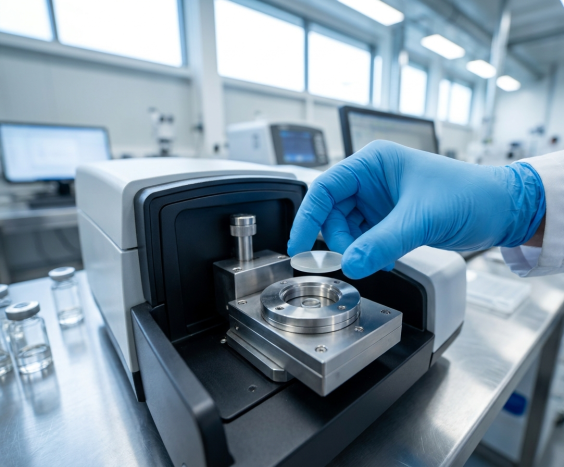
FTIR Microscopy combines infrared spectroscopy with microscopy to analyze the chemical composition at a microscopic level. It is a widely used technique for analyzing a variety of materials, ranging from bulk materials to thin films and small inclusions. It is particularly useful in failure analysis, quality control, and research applications because it provides precise chemical fingerprints along with spatial information.
FTIR testing evaluates:
- Chemical composition and functional group identification
- Molecular bonding and structural changes
- Contaminants and unknown material identification
- Degradation, oxidation, and aging behavior
- ATR-FTIR for direct surface analysis with minimal preparation
- Transmission FTIR for bulk analysis using films or pellets
Applications
- Failure evaluation
- Contamination investigation
- Peripheral analysis
- Inclusion analysis
- Fiber evaluation
- Multilayer sample analysis
- Material dispersion studies
- Research and development investigations
Benefits
- Combines imaging and chemical analysis in one technique
- Provides molecular-level identification
- Generates chemical distribution maps
- Detects contaminants and impurities
- Analyzes micro-sized particles and inclusions
- Non-destructive or minimally destructive testing
- Supports real-time monitoring of chemical changes
- Improves understanding of material heterogeneity
FTIR Test Process
Sample Preparation & Imaging
Sample is sectioned or mounted, and an optical microscope is used to locate the area or particle of interest.
1IR Exposure & Spectral Collection
A focused IR beam is directed onto the selected micro-region, and the absorption spectrum is acquired.
2Fourier Transformation & Mapping
Convert signal to frequency spectrum and collect spectra for mapping.
3Data Interpretation
Functional groups and material composition are identified using spectral libraries and databases.
4FTIR Technical Specifications
| Parameter | Details |
|---|---|
| Standard | ASTM E1252, ASTM E168 |
| Wavenumber Range | ~4000–400 cm⁻¹ (mid-IR region) |
| Measurement Modes | ATR, transmission, diffuse reflectance (DRIFTS), reflection |
| Detection Limit | Typically ~0.1–1% concentration (method dependent) |
| Spatial Resolution | Micron-level (instrument dependent) |
| Analysis Type | Qualitative and Semi-Quantitative |
| Output | IR spectra and chemical maps/images |
| Sample Types | Solids, particles, thin films, fibers, multilayers |
Instrumentation Used for Testing
- FTIR spectrometer
- Infrared microscope attachment
- IR detector (MCT or DTGS)
- Motorized mapping stage (for imaging)
- ATR or transmission microscope accessories
- Optical imaging system
- Spectral database software
- Data processing and imaging software
Results and Deliverables
- Microscopic IR spectra
- Functional group identification
- Chemical composition analysis
- Chemical distribution maps
- Contaminant identification report
- Inclusion and defect characterization
- Multilayer structure analysis
- Comparative material evaluation report
Frequently Asked Questions
FTIR can identify a wide range of materials including polymers, plastics, coatings, oils, pharmaceuticals, chemicals, and organic compounds by analyzing their unique infrared absorption spectrum, which acts as a molecular fingerprint for precise identification.
ATR-FTIR analyzes surface layers with minimal sample preparation, while transmission FTIR measures bulk properties using thin samples or pellets, providing higher spectral detail but requiring more careful preparation and controlled sample thickness.
FTIR typically detects substances at concentrations around 0.1–1%, depending on sample type, preparation method, and instrument sensitivity, making it suitable for qualitative and semi-quantitative analysis across a wide range of materials.
FTIR is not very sensitive when you are trying to detect trace amounts of certain compounds, and when you have mixed samples, the peaks can overlap, making it difficult to interpret the data. And you are only as good as your library of reference spectra.
FTIR operates in the mid-infrared region ranging from approximately 4000 to 400 cm⁻¹, where most molecular vibrations occur, allowing identification of functional groups and chemical structures through characteristic absorption peaks.
Why Choose Infinita Lab
for Electron Energy Loss
Spectroscopy (EELS)?
At the core of this breadth is our network of 2,000+ accredited labs in the USA, offering access to over 10,000 test types. From advanced metrology (SEM, TEM, RBS, XPS) to mechanical, dielectric, environmental, and standardized ASTM/ISO testing, we give clients unmatched flexibility, specialization, and scale. You are not limited by geography, facility, or methodology – Infinita connects you to the right testing, every time.

Looking for a trusted partner for Electron Energy Loss Spectroscopy (EELS) Testing?
Send query us at hello@infinitlab.com or call us at (888) 878-3090 to learn more about our services and how we can support you.




Request a Quote
Submit your material details and receive testing procedures, pricing, and turnaround time within 24 hours.
 Quick Turnaround and Hasslefree process
 Confidentiality Guarantee
 Free, No-obligation Consultation
 100% Customer Satisfaction
