


Field Metallographic Replication FMR Testing Services
Field Metallographic Replication (FMR) is a technique used to analyze the microstructure of metallic materials in-situ, without the need for laboratory-based sample preparation. It involves making a replica or impression of the material's surface using a specialized replication material.
TRUSTED BY


Get compliant results — request your field metallographic replication FMR testing quote
- Overview
- Scope, Applications, and Benefits
- Test Process
- Specifications
- Instrumentation
- Results and Deliverables
What Is Field Metallographic Replication FMR?
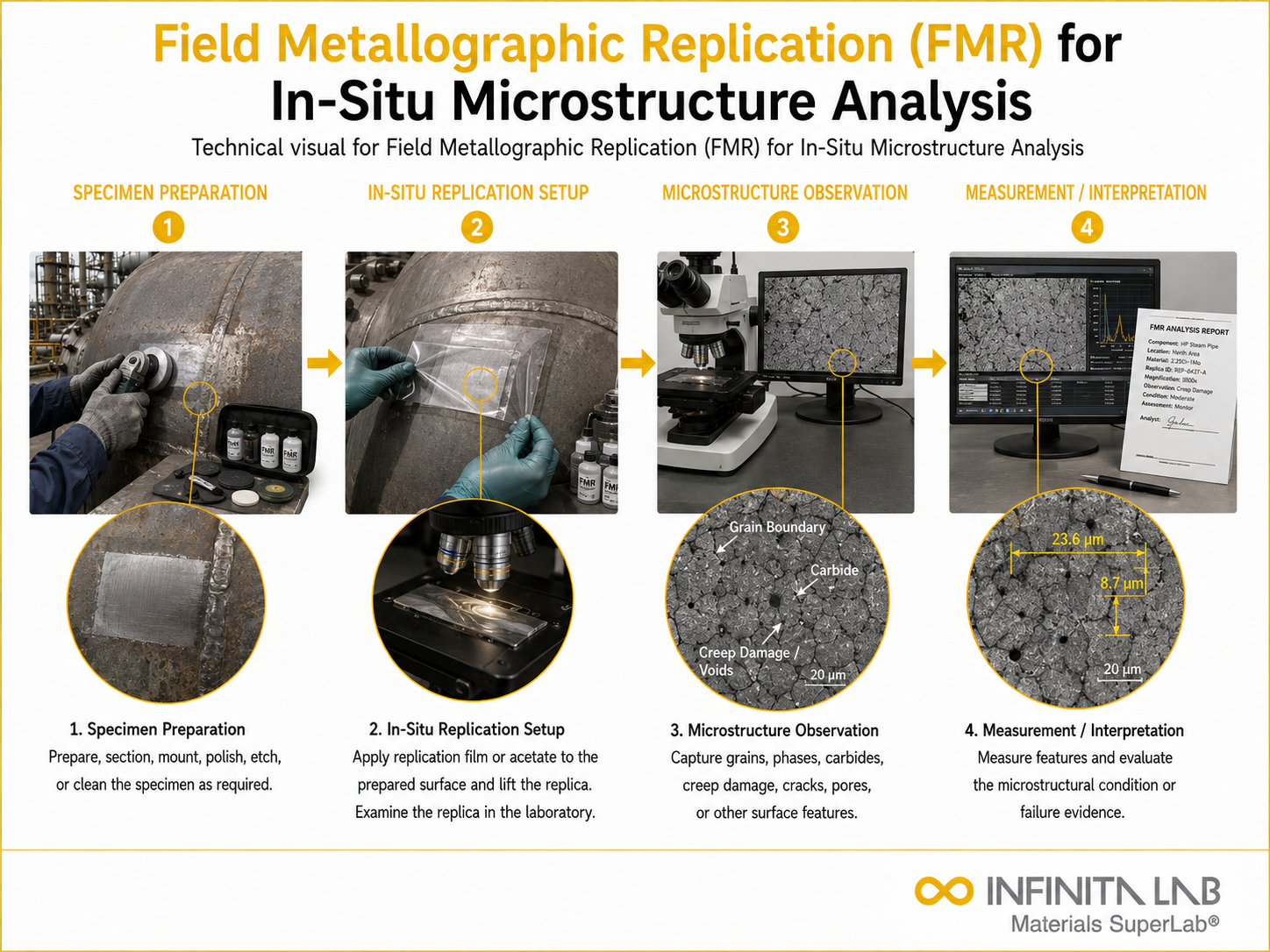
Field Metallographic Replication (FMR) is a non-destructive surface replication technique that captures the microstructural detail of in-service components — such as pressure vessels, pipelines, turbine blades, and structural welds — directly in the field, without cutting or removing material from the component.
Acetate or polymer replicas are made from the polished and etched component surface and then returned to the laboratory for microscopic examination, enabling precise characterisation of grain structure, creep damage, corrosion, and microstructural degradation in critical assets.

Applications and Benefits of Field Metallographic Replication FMR Testing
Scope
Field Metallographic Replication (FMR) is an effective in-situ microstructural evaluation technique used to assess the condition and degradation of metallic components without sectioning or damaging the part. It is widely used in life assessment, failure prevention, and integrity monitoring of critical equipment operating under high-temperature and high-stress conditions.
FMR typically evaluates:
- Grain size and the condition of grain boundaries
- Creep void density and creep damage classification
- Weld heat-affected zone (HAZ) microstructure
- Graphitisation, spheroidization, and carbide precipitation
- Surface corrosion, oxidation, and pitting damage
Applications
- Power plant boiler and steam pipe fitness-for-service assessment
- Pressure vessel and piping remaining life evaluation
- Turbine blade and hot section component inspection
- Weld quality verification on in-service structures
- Petrochemical plant turnaround inspection programs
Benefits
- Non-destructive — no material removal from the component
- Enables microstructural assessment without plant shutdown
- Cost-effective alternative to coupon cutting and laboratory sectioning
- Provides data for remaining life assessment and maintenance planning
- Documents microstructural condition for regulatory compliance
Our Testing Procedure
Surface Preparation
Inspection area is ground and polished to a metallographic finish.
1Chemical Etching
Suitable etchant is applied to reveal the microstructure.
2Replica Preparation
Replication film/compound is applied and removed to capture the microstructure.
3Laboratory Examination
Replica is analyzed under microscopy and findings are reported.
4Test parameters and requirements
| Parameter | Details |
|---|---|
| Replica Materials | Cellulose acetate tape, polyvinyl siloxane compounds |
| Resolution | ~0.5 µm (light microscopy), ~50 nm (SEM) |
| Applicable Materials | Ferritic, austenitic, and duplex steels; Ni alloys |
| Magnification Range | 100×–2000× (LOM and SEM) |


- Portable grinding and polishing kit (field use)
- Portable etching materials and PPE
- Cellulose acetate replication tape or equivalent
- Optical metallographic microscope
- SEM (for high-resolution replica examination)
- Image analysis software for grain size and void count
Equipment and Instrumentation Used for Testing
What You Receive: Test Report, Data, and Certification
- Optical and/or SEM micrographs of replicas
- Grain size measurement (ASTM E112)
- Creep damage classification (A–E per Neubauer-Wedel scale)
- Microstructural anomalies and degradation description
- Remaining life assessment input data
- Field metallographic replication report
Field Metallographic Replication FMR FAQs
FMR is considered non-destructive to the component because no material is removed. The surface is locally polished (up to a few micrometers depth), which is typically acceptable for in-service components but should be confirmed with the relevant fitness-for-service code (API 579, EN 13445).
FMR is applicable to most metallic alloys including carbon steels, Cr-Mo steels (2.25Cr-1Mo, 9Cr-1Mo), austenitic stainless steels, and nickel-based superalloys. The etchant selection is alloy-specific.
Creep damage is classified using the Neubauer-Wedel scale (Classes A–E), where Class A is no damage and Class E represents macro-crack formation. Void count and distribution are the primary assessment criteria visible in FMR replicas.
FMR captures only the surface microstructure to a depth of a few micrometres. Sub-surface creep damage or internal cracking requires complementary techniques such as TOFD, PAUT, or laboratory cross-sectioning.
Surface preparation and replication at each location typically takes 30–90 minutes depending on surface condition and alloy. Multiple locations can be sampled during a single shift, making FMR efficient for plant turnaround inspections.
Why Choose Infinita Lab for Field Metallographic Replication FMR Testing
At the core of this breadth is our network of 2,000+ accredited laboratories across the USA, offering access to over 10,000 testing methods and analytical services. From advanced materials characterization (SEM, TEM, RBS, XPS) to mechanical, chemical, environmental, biological, and standardized ASTM/ISO-compliant testing, we deliver unmatched flexibility, specialization, and scale. You are never limited by geography, facility, or methodology — Infinita Lab connects you to the right expertise and testing solution, every time.

Looking for an Accredited Partner for Field Metallographic Replication FMR Testing?
Send query us at hello@infinitalab.com or call us at (888) 878-3090 to learn more about our services and how we can support you.



Request a Quote
Submit your material details and receive testing procedures, pricing, and turnaround time within 24 hours.
 Quick Turnaround and Hasslefree process
 Confidentiality Guarantee
 Free, No-obligation Consultation
 100% Customer Satisfaction
