


ASTM A923: Duplex Stainless Intermetallic Phase Testing Services
Accredited ASTM A923 duplex stainless intermetallic phase testing from Infinita Lab, performed to the exact standard requirements - accurate, reproducible results with full documentation for compliance, R&D, and quality control programs.
TRUSTED BY


Get ASTM A923 compliant results - request your duplex stainless intermetallic phase testing quote
- Overview
- Scope, Applications, and Benefits
- Test Process
- Specifications
- Instrumentation
- Results and Deliverables
What Is ASTM A923 Duplex Stainless Intermetallic Phase?
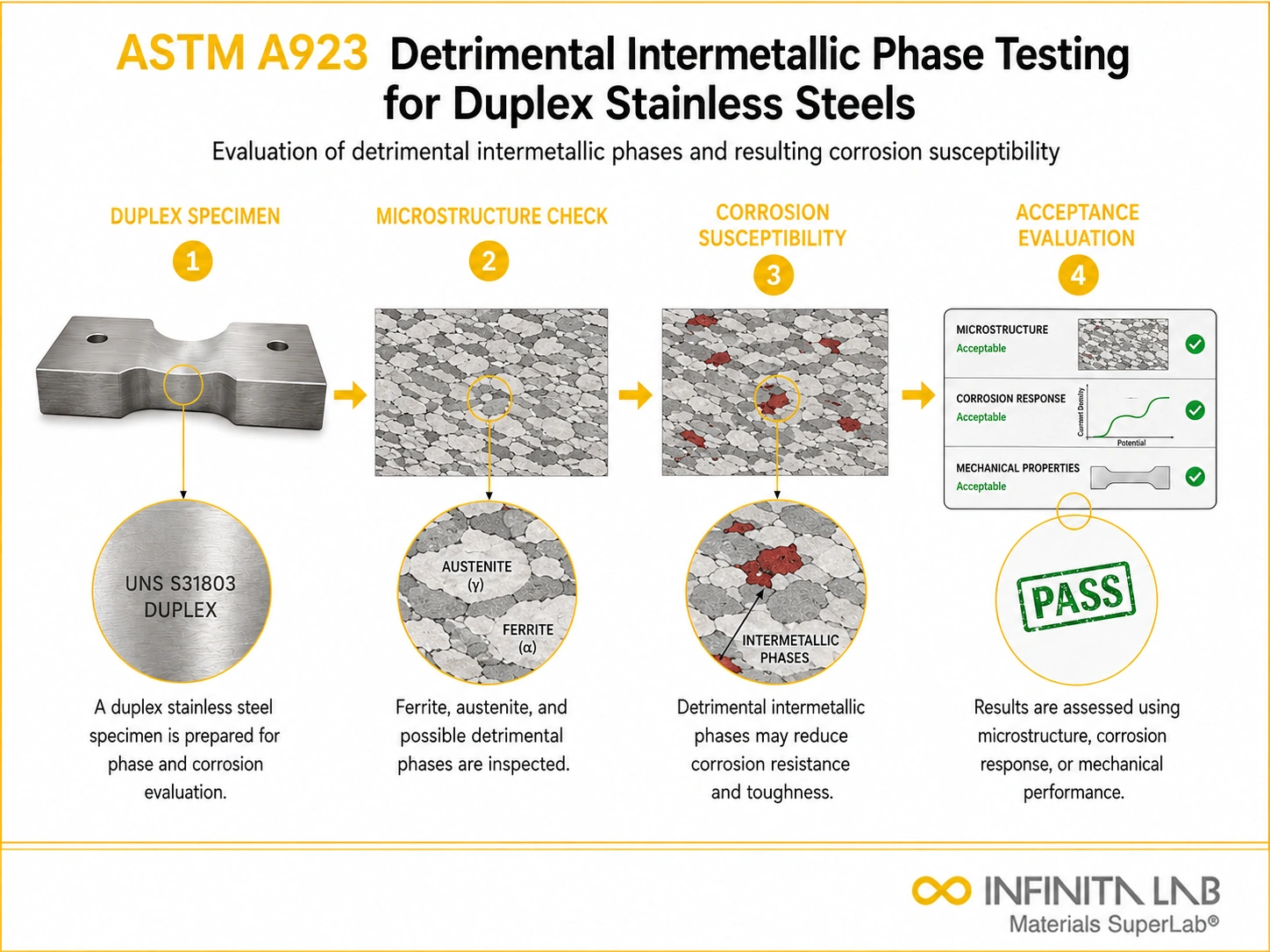
ASTM A923, “Standard Test Methods for Detecting Detrimental Intermetallic Phase in Wrought Duplex Austenitic/Ferritic Stainless Steels,” provides three independent evaluation routes for confirming that a duplex stainless steel product has not developed harmful intermetallic constituents during production, heat treatment, or welding. Duplex grades derive their strength and corrosion resistance from a balanced austenite/ferrite microstructure. Still, that balance is fragile: exposure within a critical temperature window, roughly 600°F to 1750°F (320°C to 955°C), can trigger precipitation of sigma phase, chi phase, secondary austenite, nitrides, or alpha-prime. These constituents form along grain boundaries, consuming chromium and molybdenum from the surrounding matrix and leaving the material embrittled and locally depleted in the alloying elements that provide corrosion resistance.
A923 addresses this risk with three complementary test methods rather than a single pass/fail check. Method A is a rapid sodium hydroxide (NaOH) etch test in which a polished specimen is etched, and the resulting microstructure is classified under a metallurgical microscope, offering a fast, low-cost screening step. Method B is a Charpy impact test that measures absorbed energy to detect embrittlement caused by intermetallic phases, since even small amounts of sigma or chi phase can sharply reduce toughness before they are visible metallographically. Method C is a ferric chloride corrosion test that exposes specimens to an oxidising chloride environment to reveal the loss of pitting corrosion resistance associated with chromium- and molybdenum-depleted zones near intermetallic particles.
Because intermetallic phases can escape detection by one method while showing up clearly in another, specifiers frequently invoke more than one A923 practice for critical components. Reliable, standardised testing under A923 gives fabricators, mills, and end users objective, repeatable evidence that duplex and super duplex stainless steel components will deliver the toughness and corrosion performance their service conditions demand.

Applications and Benefits of ASTM A923 Duplex Stainless Intermetallic Phase Testing
Scope
- ASTM A923 defines three distinct test methods, referred to as Methods A, B, and C, each capable of independently detecting detrimental intermetallic phases in wrought duplex stainless steel.
- Method A is a sodium hydroxide (NaOH) etch test that develops and classifies the etched microstructure of a polished specimen to screen for intermetallic phases.
- Method B is a Charpy impact test that evaluates absorbed impact energy, since intermetallic phases reduce toughness even in amounts too small to identify reliably under a microscope.
- Method C is a ferric chloride corrosion test that immerses specimens in an oxidising chloride solution to detect the reduced pitting corrosion resistance associated with intermetallic precipitation.
- Detrimental intermetallic phases such as sigma and chi form when duplex stainless steel is held or cools slowly through a critical temperature range during solution annealing, welding, or subsequent thermal exposure.
- These phases precipitate preferentially at ferrite/austenite grain boundaries, locally depleting the surrounding matrix of chromium and molybdenum and producing embrittlement and reduced corrosion resistance without necessarily changing the material’s bulk composition.
- The standard applies to wrought duplex austenitic/ferritic stainless steel mill products, including standard duplex grades such as 2205 (UNS S31803/S32205) and super duplex grades such as 2507 (UNS S32750), as well as lean duplex grades.
- A923 testing is widely specified for plate, pipe, fittings, forgings, and weldments used in oil and gas, offshore, chemical processing, and desalination service, where both mechanical toughness and resistance to chloride-induced pitting and crevice corrosion are essential.
- Testing under A923 supports mill certification, incoming material acceptance, heat-treatment and welding procedure qualification, and failure investigation when a duplex component underperforms in service.
- The standard notes that these methods are intended to detect losses of toughness or corrosion resistance caused specifically by intermetallic phases, and are not intended to detect degradation from other, unrelated causes.
Applications
- Qualification of duplex and super duplex stainless steel piping, pipe fittings, and pressure vessel components for oil and gas production and transport.
- Verification of heat-treatment adequacy on solution-annealed duplex plate, forgings, and castings before fabrication.
- Weld procedure qualification and production weld verification for duplex stainless steel structures exposed to chloride-rich environments.
- Screening of offshore platform and subsea equipment components where both impact toughness at low service temperatures and pitting resistance are design requirements.
- Evaluation of desalination plant components, such as heat exchangers, piping, and pressure vessels, that rely on duplex alloys for chloride corrosion resistance.
- Quality assurance testing for chemical and petrochemical processing equipment fabricated from duplex stainless steel.
- Root-cause investigation of in-service failures or cracking suspected to involve intermetallic embrittlement.
Benefits
- Provides three independent, standardised detection routes so that intermetallic phases missed by one method can be caught by another.
- Enables rapid, cost-effective screening of production and incoming material through the Method A etch test before committing to more time-intensive mechanical or corrosion testing.
- Directly quantifies the practical consequences of intermetallic phase formation through measured impact energy (Method B) and corrosion behaviour (Method C), rather than relying on visual assessment alone.
- Supports objective acceptance decisions for mill certification, procurement, and welding procedure qualification of duplex stainless steel.
- Reduces the risk of in-service brittle fracture or premature pitting corrosion failure in critical duplex stainless steel components.
- Generates documented, third-party test records that support traceability, regulatory compliance, and customer specification requirements.
Our ASTM A923 Testing Procedure
Sample Preparation
Specimens are sectioned, polished, and prepared for testing.
1Test Method Selection
Appropriate practice (A, B, or C) is selected based on requirements.
2Testing
Metallographic, impact, or corrosion tests are conducted to detect phases.
3Data Recording & Evaluation
Results are analyzed to determine the presence of intermetallic phases.
4ASTM A923 Test Parameters and Requirements
| Parameter | Details |
|---|---|
| Applicable Materials | Duplex ferritic-austenitic stainless steels |
| Test Methods | Practice A (Metallography), B (Charpy impact), C (Corrosion test) |
| Impact Energy (Practice B) | ≥ 54 J (typical acceptance) |
| Corrosion Test | Ferric chloride solution (~6% FeCl₃) |
| Test Temperature | ~-46°C (impact testing) |
| Measured Outputs | Phase presence, toughness, corrosion resistance |


- Sodium hydroxide etching bath and reagents – used to develop the etched microstructure examined under Method A.
- Metallurgical microscope – used to examine and classify etched specimen microstructures for intermetallic phases.
- Specimen preparation equipment (cutting, mounting, grinding, and polishing systems) – produces metallographic sections and impact/corrosion specimens meeting the required surface finish and dimensional accuracy.
- Charpy impact testing machine – applies a calibrated pendulum impact to notched specimens and measures absorbed energy for Method B evaluation.
- Ferric chloride immersion test apparatus – provides controlled, temperature-regulated exposure of specimens to ferric chloride solution for Method C corrosion testing.
- Analytical balance – measures specimen mass before and after corrosion exposure to determine mass loss under Method C.
- Temperature-controlled test chambers/baths – maintain the specified test temperatures required for Charpy impact and ferric chloride corrosion testing.
Equipment and Instrumentation Used for ASTM A923 Testing
What You Receive: Test Report, Data, and Certification
- A detailed test report documenting which A923 method(s) were performed, the applicable specimen locations, and the test conditions used.
- Etch structure classification results and representative photomicrographs for Method A testing.
- Measured Charpy impact energy values and test temperatures for Method B testing.
- Corrosion test results, including mass loss and pitting observations, for Method C testing.
- A clear conformance determination against the acceptance criteria specified in the governing product specification or purchase order.
- Traceable, accredited documentation suitable for mill certification packages, procurement records, and regulatory or customer submittals.
ASTM A923 Duplex Stainless Intermetallic Phase FAQs
ASTM A923 includes heat treatment condition, ferrite-austenite balance, test method selection, exposure temperature, and evaluation criteria, detecting detrimental intermetallic phases in duplex stainless steels affecting corrosion resistance and toughness.
ASTM A923 includes Methods A, B, and C, involving sodium hydroxide etch, Charpy impact testing, and ferric chloride corrosion testing to detect intermetallic phases.
ASTM A923 is commonly applied to duplex and super duplex stainless steels used in chemical processing, oil and gas, and marine environments.
ASTM A923 evaluates presence of intermetallic phases, impact toughness reduction, and corrosion resistance, indicating material susceptibility to embrittlement and degradation.
ASTM A923 evaluates intermetallic phases under controlled laboratory conditions and may not fully represent service environments where additional factors influence material performance.
ASTM A923 uses three methods - sodium hydroxide etching, Charpy impact testing, or ferric chloride corrosion testing - to detect detrimental intermetallic phases in duplex stainless steels.
ASTM A923 Method C is the ferric chloride corrosion test. It evaluates duplex stainless steel for detrimental intermetallic phases by measuring corrosion behavior after exposure to ferric chloride under specified conditions.
The latest active edition is ASTM A923-25, titled Standard Test Methods for Detecting Detrimental Intermetallic Phase in Duplex Austenitic/Ferritic Stainless Steels. It was published in September 2025.
Why Choose Infinita Lab for Duplex Stainless Intermetallic Phase Testing
When your Duplex Stainless Intermetallic Phase results have to hold up - for compliance, a customer audit, or an engineering decision - ASTM A923 accuracy and an unbiased third-party report matter more than price. Infinita Lab routes your ASTM A923 duplex stainless intermetallic phase testing to ISO/IEC 17025-accredited U.S. partner labs with hands-on method experience, so you get defensible data, transparent reporting, and turnaround times built around your project deadline - not ours.

Need ASTM A923 Duplex Stainless Intermetallic Phase Testing You Can Rely On?
Send query us at hello@infinitalab.com or call us at (888) 878-3090 to learn more about our services and how we can support you.



Request a Quote
Submit your material details and receive testing procedures, pricing, and turnaround time within 24 hours.
 Quick Turnaround and Hasslefree process
 Confidentiality Guarantee
 Free, No-obligation Consultation
 100% Customer Satisfaction
